OSI 7계층과 TCP/IPThe OSI 7-Layer Model and TCP/IP
OSI 7계층과 TCP/IP 비교 분석Comparing the OSI 7-layer model and TCP/IP

초기 네트워크 환경
미국 국방부의 ARPANET(Advanced Research Projects Agency Network)은 1969년에 시작된 최초의 패킷 스위칭 네트워크로, 현대 인터넷의 기원이 되었습니다.
1960년대와 70년대 초기 컴퓨터 네트워크는 각 제조사별로 독자적인 방식으로 구현되었고, 이 시스템들은 서로 호환되지 않는 문제가 있었습니다. 그리고 점차 네트워크가 확장되면서 시스템 간의 통신 문제가 발생했습니다.
이러한 상황에서 크게 두 가지 대해 논의하기 시작했습니다.
- 복잡한 네트워크 통신을 관리하기 위한 체계적인 구조 → OSI 7계층
- 서로 다른 시스템 간 통신을 위한 표준화된 규칙 → 프로토콜
OSI 7계층 모델의 탄생 배경
1970년대 중반, 네트워크 기술이 급속도로 발전하면서 다양한 네트워크 시스템 간의 호환성 문제가 심각해졌습니다. 이에 국제표준화기구(ISO)는 1977년부터 개방형 시스템 간 상호 연결을 위한 표준 모델 개발에 착수했습니다.
1984년, ISO는 OSI(Open Systems Interconnection) 참조 모델을 공식적으로 발표했습니다. 이 모델의 목적은 아래와 같습니다.
- 네트워크 통신 과정을 논리적인 계층으로 분리하여 복잡성 관리
- 각 계층의 표준화를 통한 다양한 시스템 간 호환성 확보
- 각 계층이 독립적으로 발전할 수 있는 모듈화된 구조 제공
OSI 7계층의 구조
OSI 모델은 네트워크 통신 과정을 7개의 계층으로 나누었습니다. 이러한 계층화는 복잡한 네트워크 통신 과정을 체계적으로 이해하고 관리할 수 있게 해주었습니다.
- 물리 계층 (Physical Layer): 비트 전송을 위한 전기적, 물리적 특성 정의
- 데이터 링크 계층 (Data Link Layer): 노드 간 데이터 전송, 오류 감지/수정
- 네트워크 계층 (Network Layer): 패킷 라우팅, 논리적 주소 지정
- 전송 계층 (Transport Layer): 종단 간 통신 제어, 신뢰성 있는 데이터 전송
- 세션 계층 (Session Layer): 통신 세션 설정, 유지, 종료
- 표현 계층 (Presentation Layer): 데이터 형식 변환, 암호화
- 응용 계층 (Application Layer): 사용자 인터페이스, 이메일, 파일 전송 등
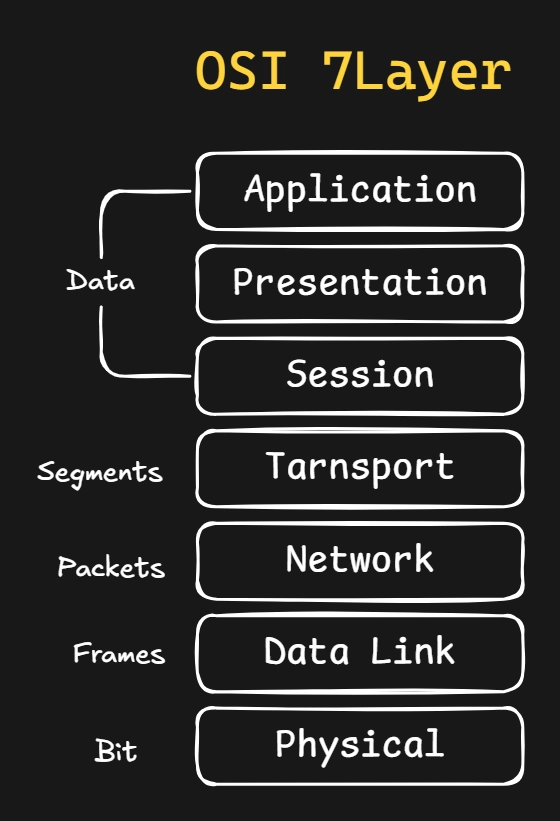
> OSI 7계층 구조
TCP/IP 프로토콜의 탄생
프로토콜은 컴퓨터나 네트워크 장치들이 서로 통신할 때 따르는 규칙의 집합입니다. 초기에는 각 회사나 기관이 독자적인 프로토콜을 개발했지만, 이는 상호운용성 문제를 일으켰습니다.
1974년, 빈트 서프(Vint Cerf)와 밥 칸(Bob Kahn)은 TCP(Transmission Control Protocol)를 개발했고, 이후 TCP/IP로 발전했습니다. 이 프로토콜은 다양한 네트워크를 연결하는 “인터넷” 개념의 기초가 되었습니다.
OSI 7계층과 TCP/IP 모델
OSI 모델은 이론적으로 견고했지만, 실제로는 TCP/IP 모델이 인터넷의 표준으로 자리 잡았습니다. 일부 계층(특히 세션 계층과 표현 계층)의 실제 구현 사례가 적은것을 보면, TCP/IP 모델이 왜 더 널리 채택되었는지 알수 있습니다.
TCP/IP 프로토콜 구조
OSI 7계층에 대응되는 계층을 여러개를 묶어서 스택이라 합니다. TCP/IP 프로토콜 스택은 다음과 같은 4계층으로 구성됩니다.
- 네트워크 액세스 계층(Network Access Layer): MAC 주소, ARP 등 물리적 네트워크와의 연결을 담당.
- 인터넷 계층 (Internet Layer): IP를 통해 데이터의 경로를 설정하고 패킷을 전달.
- 전송 계층 (Transport Layer): TCP와 UDP로 데이터 전송의 신뢰성 또는 속도를 조절.
- 응용 계층 (Application Layer): HTTP, FTP, SMTP 등 사용자와 직접 상호작용하는 프로토콜.
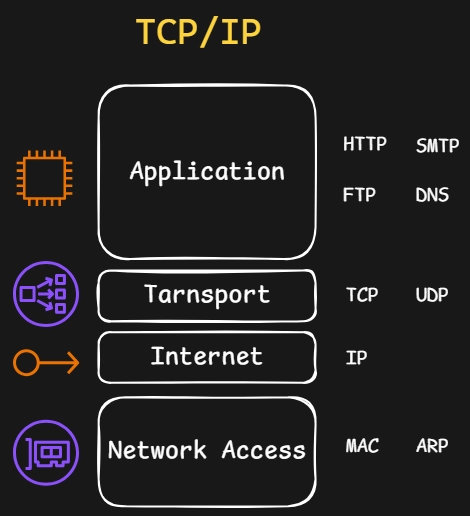
> TCP/IP 프로토콜 스택
OSI 7계층과 TCP/IP 대응 관계
이론적 OSI 모델과 실용성을 갖춘 TCP/IP 모델은 각자의 역할과 의미를 가지고 있습니다. OSI는 네트워크 교육과 설계에 중요한 참조 모델로써, TCP/IP 모델은 실제 인터넷 통신의 표준으로 사용됩니다.
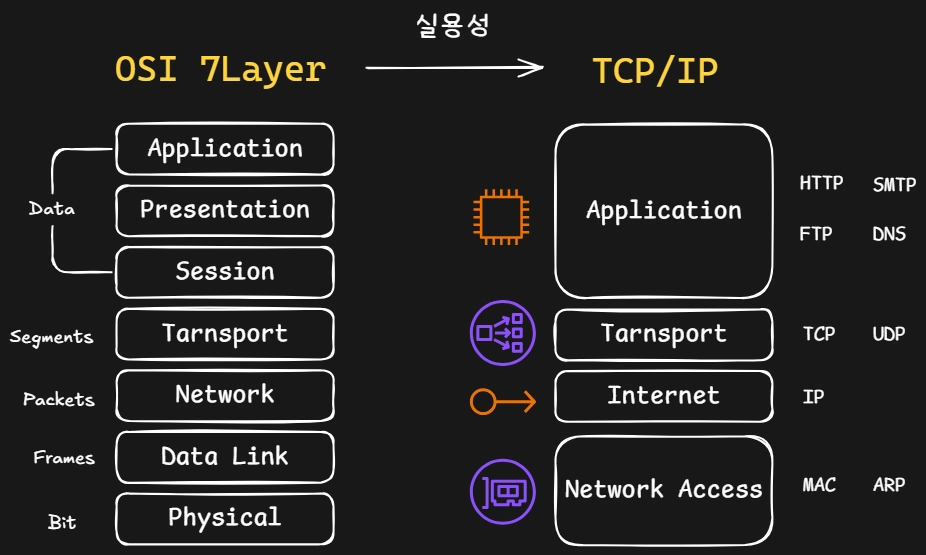
> OSI 7계층 개념을 실용성 있는 만든 TCP/IP
물리 계층 + 데이터 링크 계층 = 네트워크 액세스 계층
- 주요 기능
- 물리적 연결 및 전기적 신호 변환
- MAC 주소 기반 통신 및 오류 제어
- 주요 프로토콜:
MAC,ARP,Ethernet - 주요 장비: 허브, 스위치, NIC(Network Interface Card)
네트워크 계층 = 인터넷 계층
- 주요 기능
- 라우팅(경로 설정)
- 논리적 주소(IP) 기반 통신
- 패킷 단편화 및 재조립
- 주요 프로토콜:
IP,ICMP - 주요 장비: 라우터
전송 계층 = 전송 계층
- 주요 기능
- 종단간(End-to-End) 통신 제어
- 신뢰성 있는 데이터 전송(TCP)
- 포트 번호를 통한 프로세스 식별
- 주요 프로토콜:
TCP,UDP - 주요 장비: 로드밸런서, 방화벽
세션 + 표현 + 응용 계층 = 응용 계층
- 주요 기능
- 통신 세션의 설정/유지/종료, 대화 제어, 동기화 지점 관리
- 데이터 형식 변환, 암호화/복호화, 압축/압축 해제
- 사용자 서비스 제공(웹, 이메일, 파일 전송), 애플리케이션 간 통신, 사용자 인터페이스 제공
- 주요 프로토콜:
HTTP,SMTP,FTP,DNS - 주요 장비: 애플리케이션 서버, L7 로드 밸런서, WAF(Web Application Firewall)
마무리
OSI 7계층 모델과 TCP/IP는 각자의 역할과 의미를 가지고 있습니다.
- OSI 7계층 모델은 네트워크 교육과 설계에 중요한 참조 모델
- TCP/IP는 실제 인터넷 통신의 기반으로 사용
OSI 7계층과 TCP/IP 모델은 네트워크의 기본이지만, 단순히 이론만으로는 이해하기 어렵습니다. 앞으로 실습을 통해 각 계층의 주요 프로토콜과 네트워크가 어떻게 동작하는지 좀더 자세히 알아보겠습니다.
감사합니다!😊
참고 문헌
Early Network Environments
ARPANET (Advanced Research Projects Agency Network), run by the U.S. Department of Defense, was the first packet-switching network. It started in 1969 and became the origin of today’s internet.
In the 1960s and early ’70s, computer networks were implemented in each manufacturer’s own proprietary way, and these systems were not compatible with one another. As networks grew, communication between systems became a real problem.
Against this backdrop, discussion started around two main questions.
- A systematic structure for managing complex network communication → the OSI 7 layers
- Standardized rules for communication between different systems → protocols
Why the OSI 7-Layer Model Was Created
In the mid-1970s, network technology developed rapidly, and compatibility between different network systems became a serious problem. In response, the International Organization for Standardization (ISO) began developing a standard model for interconnecting open systems in 1977.
In 1984, ISO officially published the OSI (Open Systems Interconnection) reference model. Its goals were:
- Manage complexity by splitting network communication into logical layers
- Achieve compatibility across different systems through standardization of each layer
- Provide a modular structure in which each layer can evolve independently
Structure of the OSI 7 Layers
The OSI model divides network communication into 7 layers. This layering made it possible to understand and manage the complex process of network communication systematically.
- Physical Layer: defines the electrical and physical characteristics for transmitting bits
- Data Link Layer: data transfer between nodes, error detection/correction
- Network Layer: packet routing, logical addressing
- Transport Layer: end-to-end communication control, reliable data delivery
- Session Layer: setting up, maintaining and ending communication sessions
- Presentation Layer: data format conversion, encryption
- Application Layer: user interfaces, email, file transfer, etc.
> The OSI 7-layer structure
The Birth of the TCP/IP Protocol
A protocol is a set of rules that computers and network devices follow when communicating with each other. Early on, each company or institution developed its own protocols, which led to interoperability problems.
In 1974, Vint Cerf and Bob Kahn developed TCP (Transmission Control Protocol), which later evolved into TCP/IP. This protocol became the foundation of the “internet” concept: connecting many different networks together.
The OSI 7 Layers and the TCP/IP Model
The OSI model was solid in theory, but in practice the TCP/IP model became the standard of the internet. Given how few real implementations some layers have (the session and presentation layers in particular), it’s easy to see why the TCP/IP model was adopted more widely.
TCP/IP Protocol Structure
Bundling several layers that correspond to the OSI 7 layers is called a stack. The TCP/IP protocol stack consists of these 4 layers:
- Network Access Layer: handles the connection to the physical network, such as MAC addresses and ARP.
- Internet Layer: sets the path for data and delivers packets using IP.
- Transport Layer: tunes the reliability or speed of data delivery with TCP and UDP.
- Application Layer: protocols users interact with directly, such as HTTP, FTP and SMTP.
> The TCP/IP protocol stack
How the OSI 7 Layers Map to TCP/IP
The theoretical OSI model and the practical TCP/IP model each have their own role and meaning. OSI serves as an important reference model for network education and design, while TCP/IP is used as the standard for real internet communication.
> TCP/IP made the OSI 7-layer concept practical
Physical Layer + Data Link Layer = Network Access Layer
- Main functions
- Physical connection and conversion to electrical signals
- MAC address-based communication and error control
- Main protocols:
MAC,ARP,Ethernet - Main devices: hubs, switches, NICs (Network Interface Card)
Network Layer = Internet Layer
- Main functions
- Routing (path selection)
- Communication based on logical addresses (IP)
- Packet fragmentation and reassembly
- Main protocols:
IP,ICMP - Main devices: routers
Transport Layer = Transport Layer
- Main functions
- End-to-end communication control
- Reliable data delivery (TCP)
- Identifying processes by port number
- Main protocols:
TCP,UDP - Main devices: load balancers, firewalls
Session + Presentation + Application Layers = Application Layer
- Main functions
- Setting up/maintaining/ending communication sessions, dialog control, managing synchronization points
- Data format conversion, encryption/decryption, compression/decompression
- Providing user services (web, email, file transfer), communication between applications, user interfaces
- Main protocols:
HTTP,SMTP,FTP,DNS - Main devices: application servers, L7 load balancers, WAFs (Web Application Firewall)
Wrapping Up
The OSI 7-layer model and TCP/IP each have their own role and meaning.
- The OSI 7-layer model is an important reference model for network education and design
- TCP/IP is the foundation of real internet communication
The OSI 7 layers and the TCP/IP model are the basics of networking, but they’re hard to grasp from theory alone. In upcoming posts, we’ll look more closely at each layer’s main protocols and how networks actually work, through hands-on practice.
Thanks for reading!😊